John MacInnis explores the pedagogical benefits of roleplaying in the music history classroom. The post is the first of two on teaching music history with roleplaying activities.
Florestan has heard enough. Liszt’s Transcendental Étude “Mazeppa,” he insists, is everything music should be—fierce, unstoppable, alive. Chopin disagrees, quietly but firmly: Spectacle, he suggests, is not the same as expression. The room takes sides. This is not a seminar discussion. It is a meeting of Robert Schumann’s Davidsbund, and every person at the table is a music student.
Over the past four years, I have developed and refined classroom simulation assignments of this kind for undergraduate-level music courses. The results have been encouraging. This pedagogy has transformed passive note takers into active participants who engage seriously with ideas at the heart of music history.
What Is a Classroom Simulation?
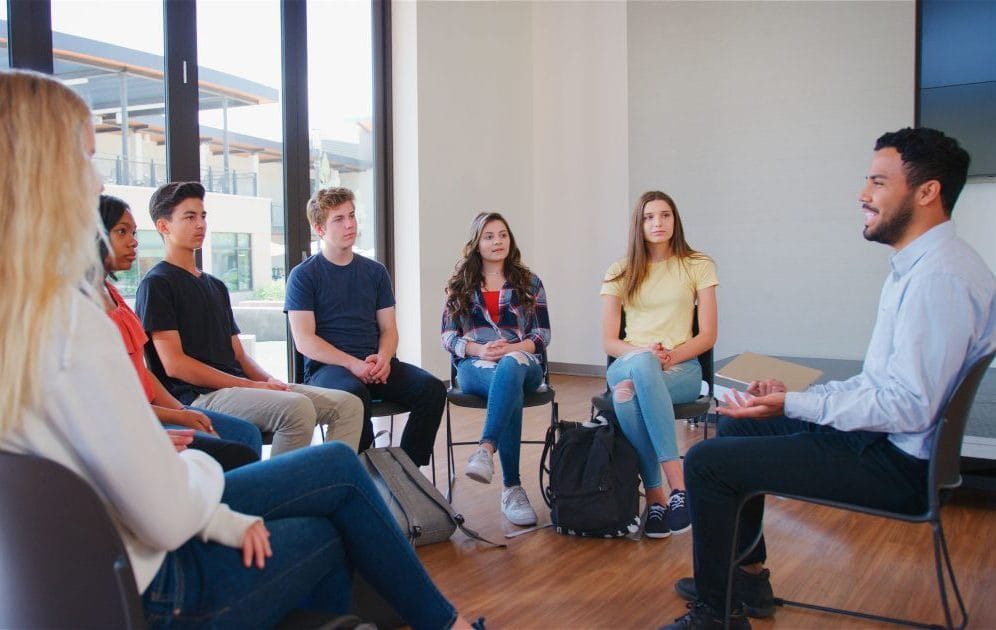
Classroom simulations are active-learning exercises in which students adopt assigned roles and work together to navigate a scenario. Drawing on the Harvard Graduate School of Education’s framing, simulations are “interactive, immersive, and intense.” They ask students to reenact a given subject’s context and manage the consequences of their individual and collective decisions. The approach is well established in medical, legal, and business education. My interest in this pedagogy was sparked by observing colleagues successfully use the “Reacting to the Past” (RTTP) model in their classrooms at my home institution. I wanted something similar, focused in scope, short in duration, and rooted in history and literature—while also allowing plenty of room for student creativity and imagination. As I learned while reading Kevin Burke’s excellent JMHP article, published RTTP simulations addressing music history courses are difficult to find. So I considered what I could build on my own.
I have now used simulations in music history, music theory, and world music classes. What follows describes three simulations developed for a course on music in the nineteenth century and some of the design principles I have used.
Simulation 1: A Davidsbündler Gathering
The first simulation draws on Robert Schumann’s League of David, or Davidsbund, a fictional society of music lovers whose debates Schumann published in the Neue Zeitschrift für Musik (NZM). In this simulation, the league convenes to discuss a provocative new work: Liszt’s Étude d’exécution transcendante, no. 4, “Mazeppa.”
Students are assigned characters from Schumann’s world: Florestan (the impassioned critic), Eusebius (the dreamer), Master Raro (the measured elder), and other figures from Carnaval, op. 9—Paganini the virtuoso, Felix Meritis the classicist, Estrella an emotionally invested listener. Real-life historical figures join them, like Chopin as the refined composer wary of excess. Schumann himself moderates. To prepare, students listen to “Mazeppa,” read an excerpt from Schumann’s Collected Writings on Music and Musicians (cf., “An Opus 2” and “Shrovetide Address by Florestan”), and prepare an in-character statement to read in class to launch the debates.
In this simulation, students do not merely argue about Liszt. They inhabit the critical culture that Schumann himself invented to argue about music. This is a hands-on and memorable way into nineteenth-century music criticism.
Simulation 2: A Festspielhaus for Bayreuth?
For the second simulation, Richard Wagner has petitioned the German town of Bayreuth for land on which to build his visionary festival theater. Students take on assigned roles: members of the town council and a group of assembled witnesses who have traveled to advocate for the project. The council (fictionally contrived for this assignment) includes a landowner with a financial stake in the existing Margravial Opera House, Minna Planer (Wagner’s first wife), and Johannes Brahms as Wagner’s musical rival. The pro-Wagner witnesses include the mayor of Bayreuth and King Ludwig II himself, among others.
Students prepare an in-character speech drawing on primary and secondary sources before class (e.g., Wagner’s “Art-Work of the Future” and entries in Oxford Music Online like “Gesamtkunstwerk”). Two structured debates examine the architectural and artistic vision of the proposed Festspielhaus. After the debates, students step out of character and submit a personal reflection on how they would actually vote and why. At my home institution, inviting faculty colleagues to observe these proceedings has given the simulation a sense of occasion that students respond to with noticeably greater care in their preparation.
Simulation 3: The War of the Romantics, “A Very Agitated Evening”
The third simulation takes place at the end of the course. Students play prominent nineteenth-century musicians attending a dinner party at the home of Robert and Clara Schumann in the spring of 1848—a gathering loosely based on a real historical event. The subject of debate is the so-called “War of the Romantics”: program music versus absolute music.1
Before the simulation, students write an analytical essay in which they define both types of music and examine works by Beethoven that exemplify each. The simulation itself spans two class periods and features four structured debates. Teams include advocates for absolute music (e.g., Eduard Hanslick, Clara Schumann, and Joseph Joachim) and for program music (e.g., Liszt, Wagner, and Hans von Bülow). I provide refreshments so that class sessions genuinely feel like a gathering. The final debate—a counterfactual imaginative exercise asking students, as nineteenth-century musicians, to speculate about the future of absolute and program music in the digital age—consistently generates the most animated exchanges of the semester.
Design Principles, Student Responses, and Assessment
Careful scaffolding is essential in these activities. Students benefit from curated source readings, written preparation tasks, and reading detailed character descriptions before arriving in class. And the in-class scenario must remain genuinely open-ended, so that students understand that the debate outcomes depend on how their arguments unfold.
Student responses have been mixed, but generally positive. Though students report that they sometimes felt awkward with roleplay, the simulations helped them see music history less as a narrative of inevitable progress and more as the work of real people with competing values.
Simulations pair well with specifications-based grading, which evaluates student work against clearly defined criteria. For both written preparation tasks and in-class performances, I use a simple three-tier rubric: work that fully meets the specifications earns full credit; work that mostly meets them earns partial credit; and work that falls significantly short earns minimal credit, sometimes with an opportunity to revise. Using rubrics like this gives students a clear target and makes the evaluation of oral work straightforward to defend.
Getting Started
For instructors considering this approach, I suggest beginning with a single class period and a tightly defined scenario. Building a scenario from scratch requires significant initial investment, but it allows precise alignment with course content. AI can assist with this process. A well-prompted AI assistant can generate preliminary character descriptions, draft debate prompts, suggest primary and secondary source pairings, and even identify historical figures whose perspectives add productive friction to a scenario. For students, AI can serve as a preparation partner. A student assigned to play Clara Schumann might use an AI tool to identify passages in her writings mentioning Wagner or to pressure-test in-character arguments before class. Used this way and fact-checked against reliable sources (due to hallucinations), AI functions less as a shortcut than as a research interlocutor. Louis Epstein’s review of Bowen and Watson’s Teaching with AI specifically mentions classroom roleplaying assignments as an area where AI can assist teaching and learning.
Speaking personally, simulation assignments let me teach the values I care about most. I want my students to carry a sense of agency into their lives and an assurance that their choices matter in a complex world. I also want them to exercise their imaginations in considering how other people think and feel. Why else have we been given imagination and opportunity to play with music if not for this?

John MacInnis teaches music history and literature, music theory, and world music at Dordt University in Sioux Center, Iowa.
Footnotes
- While using the absolute/program music binary as an organizing framework can be pedagogically defensible, the framing is itself a historiographical construction that students could also interrogate.↩