Esther Cruscuola de Laix, editor at A-R Editions, reflects on her progression from musicology graduate student to a career in music editing—and why she loves it.
“So you want to be a music editor?”
I put that question in “scare quotes” for a reason, because this article is meant less as a career path how-to than a personal sketch of how I came to want my own career—which happens to be music editing. Since August 2011, I have served on the editorial staff of A-R Editions, founded in 1962 and now one of the world’s foremost publishers of critical editions of historical music. I also manage A-R’s blog, UnderScore, which explores topics in music edition making. But during my time as a doctoral candidate in musicology between 2002 and 2009, no one ever asked anyone the question “so you want to be a [fill in the blank]?”—because in my department, as in many others, there was a very specific assumption about what everyone there wanted to be: a professor in a tenure-track position. And that wasn’t just a matter of wanted to be but also would be, given that university’s 100 percent job-placement record at that time.
For someone like me who loved learning, teaching, music, and history, that sounded like a great deal. So, when I graduated in 2009, you can imagine what a rude awakening it was when every single one of my academic job applications was unsuccessful—thanks largely to the recession of that year, which cut gashes in tenure-track hiring numbers that have yet to heal. I was jobless for over a year after finishing. (Which was not time badly spent: In April 2010 I had a baby, who is now the proud possessor of a driver’s license. Family-work balance in the academy is its own topic, of course, but it always manages to hover in the background.)
In late 2010, I came across a job opening that was different from the rest. It was for an editorial position at A-R Editions, and the main requirement was a doctorate in music—any area, any era. I thought, “Why not, I’ll give it a try?”—not least because A-R is based in Middleton, Wisconsin, outside Madison, and I liked the idea of returning to the Midwest. (I grew up in Chicago, and my mother still lived there at the time.) I applied, was given tests on my copyediting and proofreading skills (typical for such jobs), went for an interview, and eventually started the job in August 2011. The academic ideal, as one might call it, was still very strongly in my mind at that time, so I went into the job viewing it as a stopgap to tide me over until the academic market improved. I thought, “I’ll try this editor thing out for a year or two, see how it goes, and then see how the academic market looks and try again.”
But I didn’t. I stayed, and I am still here after almost fifteen years.
Why? Several reasons are easy to rattle off (and I do so with no intention of casting shade on anyone happily employed in academia). There’s the financial stability, the departmental-politics-free working environment, the lack of “publish-or-perish” pressure, the flexible hours (a godsend if you have a family, and even if you don’t), the freedom to not have to think about work between when I leave the office at 4:00 p.m. (or 3:45, or 4:30, or 5, depending on the day) and when I come in the next morning. (It is not at all wrong to want such things.) Of course, I could have had the same in any number of jobs outside the field of music (and plenty of people with musicology and other kinds of humanities degrees do, which is fine). But while working as an editor, I found I could get all those good things plus the opportunity to keep using all my training in music and scholarship. Editorial positions at A-R are probably among the only jobs in the world outside academia that require a doctorate in musicology. And for good reason: General music history knowledge, library skills, critical-thinking skills, musicianship, and the vagaries of early notation are all part of a music editor’s everyday work.
The editor job description at A-R calls for “broad knowledge of music history and musicological research methods,” but my experience is that it goes the opposite direction, too. The experience of working as an editor has the potential to expand one’s musicological horizons like few other jobs. Graduate students, and to some extent professors, spend a lot of time and energy in one specific music-historical niche, but when you work as an editor of historical music, you will by necessity delve into the nitty-gritty detail of music far outside your area of specialty—for the simple reason that publishers can only edit and publish what people send them. My dissertation work was on music in Hamburg, Germany, around 1600, but in my time at A-R I’ve edited Central American villancicos; eighteenth-century melodramas; nineteenth-century French and German organ music; Indigenous Taiwanese ritual chants; Yiddish folksongs; opera and music theater from Baroque France and Italy to the twentieth-century United States—and more motets, masses, and Magnificats than you can shake a stick at. Would a tenure-track professorship have offered the same kind of variety? Perhaps, perhaps not—but my publishing career most definitely has, in ways I never could have imagined.
I’ll end by returning to that initial question in scare quotes—“So you want to be a music editor?” There are plenty of ways to get started if one’s interested: internships and online courses in editing (like those offered by the University of Chicago, University of Washington, and UC San Diego), editorial assistantships at musicology journals (JAMS, JRMA, Journal of Musicology, and others), and even just offering to proofread your friends’ work. (Indeed most music publishing houses train their staff on the job anyway—a necessity given the unique considerations involved.) But after fifteen years in an immensely fulfilling editorial career, I think the operative word in the question might be want. A career in editing was not what I thought I wanted after grad school, but I wouldn’t change it for the world now. It’s my “plan A life,” as Susan Ferber puts it, even if it grew from a “not part of the plan” situation. And for any musicology degree holders out there who may be considering a rewarding career outside academia, it’s a path I heartily recommend.
Or, to paraphrase the Rolling Stones: You can’t always get what you want, but if you try sometimes, you get stability, flexibility, and fulfillment—which may be even better.
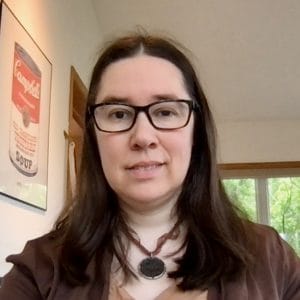
Esther Criscuola de Laix holds a PhD in musicology from the University of California, Berkeley and a BMus in organ performance from the Oberlin Conservatory of Music. Her dissertation, which received the Alvin H. Johnson AMS 50 award in 2008, investigates musical print culture in Hamburg around 1600, centering on the music of the Praetorius family. Since August 2011, Esther has worked at A-R as an editor on the Recent Researches in Music series of publications, and she has served as house editor for volumes involving European music from the Renaissance through the mid-twentieth century and traditional music from Eastern Europe, the Levant, and Taiwan. She also administers A-R’s blog, UnderScore, and serves as editorial supervisor for the Computer Music and Digital Audio series.